07 April 2012

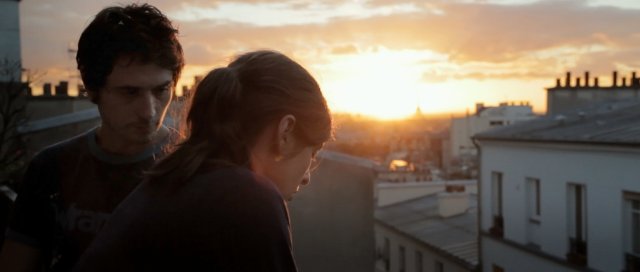
We Need To Talk About Kevin (Lynne Ramsay, 2011)

The first 30-40 minutes of this film will completely captivate the viewer. Absorbed completely by the visual imagery and pure cinematic bliss. The images forming their own emotionally overwhelming and disturbing mood that dominates the actual story being told. If the entire film would've been told like this it would've left a much more disturbing and powerful impression. When this incredible sequence ends though the film slows down its visual storytelling to focus on more traditional storytelling (a lot more dialogue, longer cause-and-effect sequences vs the earlier jagged narrative structure that was put together visually with no sense of time), the film loses some of its power. Yet it still keeps a lot of its ambiguity and reliance of the image. The overall film is highly commendable, but those first 30 or so minutes were so incredible that the rest of the film almost felt like a letdown.

A great 35mm print playing at Ciné.

06 April 2012

Declaration of War (Valérie Donzelli, 2011)

This film actually exceeded my expectations. All its quirks -and what most people considered its flaws- were my favorite aspects. Donzelli's obvious love for the cinema combined with the her honest and personal story make a powerful film. Yet the cinephilic quality was what I admired most. Clearly brought to the point of satire in the scene when the legendary doctor is introduced and we get a ridiculous zoom-in tilt serving to cue us in, 'Yes, this doctor is important!' or in the musical number halfway through. Or its nouvelle vague-type editing and narrating.

Declaration of War played at Ciné as part the FRENCH CINEMA SERIES. Other films are: Point Blank, The Father of My Children and Tomboy.

05 April 2012

The Father of My Children (2011, Mia Hansen-Løve)

"And I think this point of view reflects also what I say in the film, more deeply, and the way I see the cinema—cinema has to be connected to real life, and I wanted to make a film about cinema not as something to escape life, not as something l'amour, but cinema is being a part of life. I wanted to make a film where there was a constant dialog between film and life."

(Daniel Kasman) To drive in at a small detail, I'm curious about that old, small chapel that you filmed in the countryside, how you found it and how it worked its way into the film.

"
Actually, the teenage actress [Alice de Lencquesaing] was in my first film. She was kind of the inspiration behind this, and she has two sisters who were also inspirations for this film. She knew of this place, and really introduced this place to me, which was how I discovered the chapel. It was an instance where the decor inspired the scene rather than the scene dictating a decor I had to find. It's not to give this scene too much importance—it's really an anecdotal kind of scene—but what's really important is the little child with the ladder, where she tries to climb the ladder but is told not to, and later on the ladder is not there any more, it's been moved, and you see the ladder leading up, out of the open roof of the chapel. In my film I think that often the most important element of a scene is not the thing you think is the most obvious, sometimes a detail can be the real reason, the heart of a scene. The heart of this particular scene is that ladder."

- Mia Hansen-Løve

Full interview click here

The Father of My Children played at Ciné (on 35mm) as part the FRENCH CINEMA SERIES. Other films are: Point Blank, Declaration of War and Tomboy.

04 April 2012

Tarkovsky, 80


We all know that 54 was just way too soon.

"People have often asked me what The Zone is, and what it symbolizes, and have put forward wild conjectures on the subject. I'm reduced to a state of fury and despair by such questions. The Zone doesn't symbolize anything, any more than anything else does in my films: The Zone is a zone, it's life…"
- Andrei Tarkovsky

More here

03 April 2012

Tomboy (2011, Céline Sciamma)

Composed flawlessly with cinematography and narrative structure that mirrors the completely loose and free world of the children until the last act when Laure, played by Zoé Héran who gives a powerhouse performance, has to face the consequences of joining society and abiding by its harsh rules. Even with this loose structure and camera the film is incredibly precise, making perfect use of its 82 minutes. Céline Sciamma firmly places herself as a very strong auteur coming out of France (following her debut Water Lillies; an incredibly gorgeous and calculated film that is a much harsher look at young-adult relations) with the talent and sincereness needed to be able to explore children/young adults.

Tomboy is showing at Ciné (on 35mm) as part the FRENCH CINEMA SERIES. Anyone in the Atlanta/Athens area should definitely make it out to catch some of these fine films. More coverage on this series this week and next. It runs through the April 5. Other films are: Point Blank, Declaration of War and The Father of My Children.

02 April 2012

Brooklyn Rail & Nicole Brenez

“the fact that one can think with certain films, and not simply about them, is the irrefutable sign of their value”


Essential reading from the Brooklyn Rail,interview with Nicole Brenez (click here for article). Excerpts:

"[from] 1930s Spain, in colonial Africa since the ’50s and in the Tricontinental countries during the ’60s and ’70s. The important historical figures in this scenario are essentially communists or communist sympathizers such as Joris Ivens or René Vautier, but also anarchists such as Armand Guerra or Armand Gatti ... all of these internationalist initiatives deserve to be passed on to contemporary protest movements: Their freedom and courage resonate with current initiatives, and these filmmakers are often the ancestors of those who fight through images today. Lastly, their example and their ideals allow us to fight the current reign of nationalist or even communitarian ideologies."

"René Vautier, Jean-Luc Godard, and Jean-Pierre Gorin and their camera operator Armand Marco had the same experience and came to the same conclusion, mutadis mutandis: Though they were anxious to put themselves at the service of the struggle of people who had been colonized by their own nation, they refused nevertheless to let their images be controlled or dictated to them."

"On the contrary, the proliferation of images seems to me to be a wonderful phenomenon: more images and films in line with standardized forms, of course, but also more formal, visual, and logistical innovations. There is a sea of inventive and valuable proposals that we will need to start exploring."

"[about Film Socialisme and the short above] both emerge from a “republic of images,” in other words from forms of montage that de-hierarchize formats, techniques, textures, and qualities, to the benefit of a more far-reaching, more political perspective and at the expense of technophilic and economic criteria."

"[about taking over the experimental program at Cinémathèque Française] to do justice to such an assignment meant actively contributing to the exploration of those parts of cinema history that remain hidden, to the defense of the most radical or the most fragile movements and to the critique of prejudices and clichés, through concrete action."

"A large part of my work will have been to exhume and to highlight films that are as formally demanding as they are politically, a combination which should be self-evident since critiquing the world order entails critiquing the discursive order."

" ... and all my work is founded in the observation that the history of cinema is as unfair as the general history of humanity when it comes to recognizing its real heroes."

"[about her status in Paris III University] There will be an attempt, like everywhere else, to subjugate and asphyxiate this freedom, not through laws but through administrative and economic constraints, which are far more efficient—similarly to the economic censorship of films, which is infinitely more powerful than political censorship."

"Guerrilla initiatives come from everywhere: from underground, but also from the heart of the fortress, which is called sabotage. When Paul Verhoeven makes Starship Troopers, a super-production based on all the necessary ingredients (actors, screenplay, iconography, props, marketing), in which he represents American imperialism as Nazism, he redirects the apparatus of production itself, and that is a monumental effort, much more complicated than making a radical film in your home."

"In the long term, the effects of politically committed cinema resound infinitely and can emerge completely unexpectedly. One recent case is that of René Vautier’s A Man is Dead (Un homme est mort) ... René Vautier recounted the story in his memoirs of how the 16mm reversible film was destroyed as a result of being projected. Many interventionist films are likewise destined to disappear in the heat of action, like combatants on the front. But since then, during the course of the 2000s, this lost film has continued to generate texts, thoughts, events, concerts, and a comic strip of the same name, A Man is Dead, by Kris and Etienne Davodeau. These disappeared images, because they have disappeared, infuse a whole new generation with inspiration and energy. They have become more alive than all of the “successful” films shot that same year."

All quotes: Nicole Brenez

01 April 2012

Gance's Napoléon


To say it was one of the greatest experiences of my life might seem like hyperbole to most, yet to say anything else would sound like an understatement and the last thing I want to do is undermine how incredible this cinematic event actually was. Walking into the Paramount theater was like walking into a different era, when film played a very different role than it does now. The sheer artistry in the architecture proves this. And then we sat down. As the credits rolls goosebumps emerge in anticipation of what you are about to see. Apparently Jean Cocteau declared that "there is cinema before and after La Roue as there is painting before and after Picasso," a statement I couldn't agree more except for the fact that I think what Gance started in La Roue reached its climax in Napoléon (click here for full article from MANOHLA DARGIS). There doesn't seem to have been much, if any, cinematic advancement since this film. Camera's mounted on anything from pendulums to horses, use of multiple screens within the same frame, the most realistic and intense sea storm sequence, some of the greatest feats in editing (by Gance himself), some of the best use of superimpositions (just think of the sequence in which Napoléon meets the ghosts of the Revolution), beautiful tinting, and of course Polyvision, the precursor to Cinemascope and 3D that is undeniable superior than both; and that's barely touching all the feats of the film. And that was only half the package, there was Carl Davis and the Oakland East Bay Symphony. The concert and the film themselves would've been incredible enough yet since they were made specifically for each other this combination surpasses any expectations anyone could have.

& of course the outmost thanks to the San Francisco Silent Film Festival and Kevin Brownlow.

"Napoléon is more than a restoration, indeed it is more of a re-creation, an attempt by Brownlow to build ever closer to that original conception of the film, to re-enter the mind of Abel Gance." (full article here)