11 February 2012

Love/Not Love: Handmade Feminist Films


Yesterday I had the incredible opportunity of viewing some brilliant handmade films, courtesy of Contraband Cinema, who brings the greatest experimental films to the Atlanta area. In honor of the upcoming Valentine's Day the event was "a lovers' brew of erotic, experimental, handmade, feminist films presented by curator, writer, and scholar Gregory Zinman" (from the event page) and consisted of the following films: Naomi Uman's Removed (1999); Jennifer Reeves' The Girl's Nervy (1995); Jennifer West's Riot Grrrl Alchemy Film (2008); Carolee Schneemann's Fuses (1964-67). All magnificent 16mm prints (except Riot Grrrl). This is the type of event is what is going to keep cinema alive. When all cinemas will be showing the worst films in HD super 4D rollercoaster mode, we'll still be able to go to a small gallery and watch amazing art films on actual film. In Uman's Removed, the woman in a porn film is completely removed out of the picture (frame-by-frame) with bleach while the remainder of the frame is painted over with nail polish. The film not only subverts the male gaze but also brings up the questions of the politics of film. Can you change the political nature of a film by painting or altering it? The Girl's Nervy is an incredibly fast moving that transforms cracked paint into nerve endings. Riot Grrrl Alchemy Film was perhaps the most anarchic film of the program. The emotions of punk rock, dancers, food fight, rebellion are combined and transformed to the visual sphere. Fuses was the masterpiece of the night. Perhaps one of the only honest depictions of real sex in cinema. A film that welcomes us into the erotic world of lovemaking without arousing us because it's consistent refusal to display sex form one single perspective. Jonas Mekas called the film the most beautiful film of 1968, yet I think that might be an understatement and it is one of the most beautiful films of all-time. The best $6 I have ever spent.

10 February 2012

Notes on Auteur Theory

Cult of the Auteur: Hawks (Andrew Sarris)

- Auterism: expression of an existential humanism inflected by phenomenology. Astruc and “Birth of a New Avant-Garde: The Camera-Pen,” the camera-stylo. Truffaut and “A Certain Tendency of the French Cinema,” praising the writer/director. Cahiers du Cinema: key organ for the propagation of auteurism, attacking the established system. Andrew Sarris and the Americanization of Auteur theory. Auteurism picked up in academia by American institutes in the 1960s. Auteurism leading to subjectivism more than ontology/epistemological questions (not so much a theory). Varda using the term cine-ecriture by 1955. Rohmer and Chabrol write the first book on a single director, Hitckcock (1957). Andrew Sarris, The American Cinema (1968), argues there were artists actively at work in the Hollywood studio system. Auteurism arguing against elitism, arguing for popular directors like Hitchcock and Hawks. Peter Wollen combines Structuralism and interest in other creative personnel with auteurism. Auteurism as deciphering meaning via style (ex. Hawks), movies are not transparent objects, but texts that must be worked up. Bazin, just before his death in 1958, warning against the excesses of auteur criticism and cult of personality. Auteur critics praise and analyze weak movies by so-called auteur directors (like Hawks Monkey Business or Hitckcock’s To Catch a Thief), and ignore movies by directors they dismiss (Maltese Falcon by Huston, Casablanca by Curtiz). Marc Vernet in Aesthetics of Film, “the term auteur is too tainted by pop psychology to be allowed to be used today, too strong temptation to reduce a film to the director as sole creator.” Howard Hawks as an example: Professional camaraderie of men and women must prove themselves “worthy” of male group. Group = isolated from larger society, hints of homosexual/homosocial, marriage is not an option. Thematic oppositions: Regression/humiliation among the men. Next to every Hawks hero is another who has been stipped of his mastery. Cautionary tales with simple oppositions. To Have and Have Not (1944), The Big Sleep (1946), and Rio Bravo (1959).

The Man Who Shot Liberty Valance (Ford, 1962)

- Valance all the way on the gun side, Stoddard all the way on the book side, Doniphon somewhere in the middle. Valance a lot more savage than Doniphon, uses a whip. The law books in Young Mr. Lincoln and here. Tom is the unofficial guardian of the town. Repression in John Ford characters.

Auteur (Ford) and Genre (Western) theories

- Peter Wollen, The Auteur Theory [Hawks and Ford]. 2 school of Auteur critics: those concerned with thematic motifs and those who stressed style and mise-en-scene. Auteurs vs metteur-en-scene. Hawksian world: adventure drama vs. crazy comedy, the positive and negative poles of the Hawksian vision. Hawks’s all male community. Wollen: the auteur theory needs further development. Wollen evaluating auteur theory. For him weak auteurs simply repeat the same themes and motifs while great auteurs have shifting relations. The director as an unconscious catalyst, life/times and bio of directors, we shouldn’t focus on these. Wollen wants to stay with the film as text, not going back to the director. FORD, foreground various motifs and themes, oppositions in Ford: Garden vs Desert, Savage vs Civilization, Male vs Female.

09 February 2012

Haywire (Steven Soderbergh, 2011)


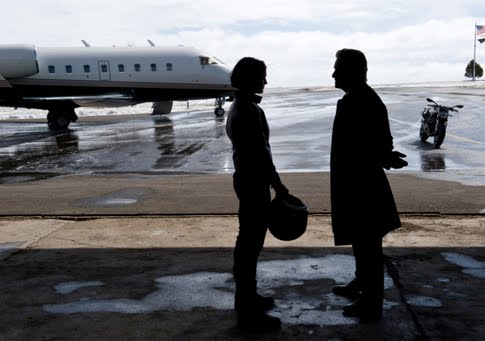
The very beginning of the film sets it up perfectly. A scene in a coffee shop that could've come straight from a Twin Peaks episode. Following the incredible Contagion, Soderbergh continues bringing avant-garde sensitivities to seemingly mainstream films, Olivier Assayas's Boarding Gate being as close of an example I can think of. Like with Contagion, Soderbergh refuses a straightforward narrative. This time around three-quarters of the film is told by our main character, Mallory (Gina Carano in an perfect, fitting performance), while in a car with someone she's just taken hostage, until time catches up with them and we are thrust into a car chase in present story time. The flashback is told entirely visually and as Mallory tells her passenger the story, since it is shot from the exterior it creates a swarm of trees to appear on their faces. We also never see Mallory telling any part of the story, except at some points when she tells her passenger to keep all the names straight, as if trying to keep all the characters in order for the audience, one of the many satirical aspects of the film (along with the plethora of cameos, some of the stilted dialogue and acting, Fassbender's demise). Soderbergh, as usual, shoots (being the cinematographer himself) the film exceptionally well paying more attention to framing, sometimes reaching a level of abstractness, than any other 'commercial' director/cinematographer. The soundtrack at its best moments becomes incredibly abstract and minimalist, reminiscent of Tindersticks' scores for Claire Denis' films. This film is a masterpiece of contemporary American genre cinema.


"Yet Carano must also deliver some dialogue, and I am convinced that her director, less wed to whys than hows, has made sure that everyone around her performs in a subtly unreal, stylized, arguably “bad” manner, embodied most perfectly by Ewan McGregor’s reediest possible American accent and most viscerally by the presence of one Channing Tatum..."

"Even on a purely visual level, Haywire is quite keenly set on upsetting expectations of audience gaze in a movie about a sexy action lady—for a helpful contrast, see last year’s Colombiana, un film de Olivier Megaton, and Zoë Saldana’s aptitude at squeezing into a body stocking she also wears as stockings—with the glamour of objectification cast entirely upon Carano’s handsome male co-stars; both Michael Fassbender and Antonio Banderas enjoy prominent chest-baring scenes, while Tatum finds himself tasked with the classic hapless, misled hero’s love interest role, and its compulsory scene of throwaway physical affection."

07 February 2012

Le Havre (Aki Kaurismäki, 2011)

My first Kaurismäki film: a wonderful blend of beautiful framing/lighting/cinematography blended with Tati-esque comedy and Fassbinder-type acting create a surreal world where problems are always around the corner... with the solutions never trailing too far behind. Also a celebration of film, actual film that is, not digital. The film's color palette and graininess seem impossible in digital filmmaking. Looking forward to exploring more of the auteur's body of work.

Daniel Kasman on the film (full article here):
"Aki Kaurismäki's blend of fable-style plotting, classical studio storytelling, and a real world context and social message, has little to do with this unusual mix of several usual kinds of films. It is, instead, lead actor’s André Wilms voice, the tenor of his line readings; a hilarious and moving collaboration between Wilms and Kaurismäki's direction, lending his spoken words a clipped, positive upward inflection in his sentences that gives the ends of lines a quality of affirmation, an enthusiastic aphorism, the punch line to a joke."

06 February 2012

Notes on Christian Metz, Textuality, & You, the Living

Specificity – is cinema a language vs other semiotic systems (Not interested in the artistic aspects on the cinema). What are the materials of expression, what are the codes and sub-codes of cinema, how does cinema create meaning, what is specific (codes) to cinema vs non-specific codes to cinema. Codes: editing, subcodes: shot sequence, montage, Shot/reverse shot. Codes: lighting, subcodes: expressionistic, natural. What is more specific to cinema? Spatial and temporal color, Technicolor of the 50s. Film history is the history of subcodes, Problems for STAM: does not engage social issues, too formalist. Problems for Bordwell: not historical enough. Marks of discourse: the story isn’t telling itself. Narrative discourse (narrative cues)= systems – selection/organization of… “Voices”, products of signifying strategies/codes. *camerawork – dialogue (spoken/v.o.) *music *lighting. Levels of narrative: Primary narrator, Secondary narrator (internal)

You, the Living (Andersson, 2007) and Levels of Narration (Neupert) - Sound in You, the Living, couterpoint to the bleak world, happy upbeat music and sad world. Nondiegetic and diegetic music. “Narrative” *order of scenes/vignettes/mini-narratives, is there a 1st level narrator? Macro narrative, begins with “I’ve dreamt bombers are coming,” ends with the bombers coming. *From Benny weeping about the electric chair to an old woman being reminded about everything she hates, what is the alternative to the electric chair, being so old you don’t remember anything? 2 functional families at the end but it’s all pointless because the bombers are coming. 1st narrator provides opening and closure, the film foregrounds what spectators do. Story fragmented by narrative discourse. Opening up a bunch of narratives but none are resolved.

05 February 2012

Passing Fancy (Yasujirô Ozu, 1933)


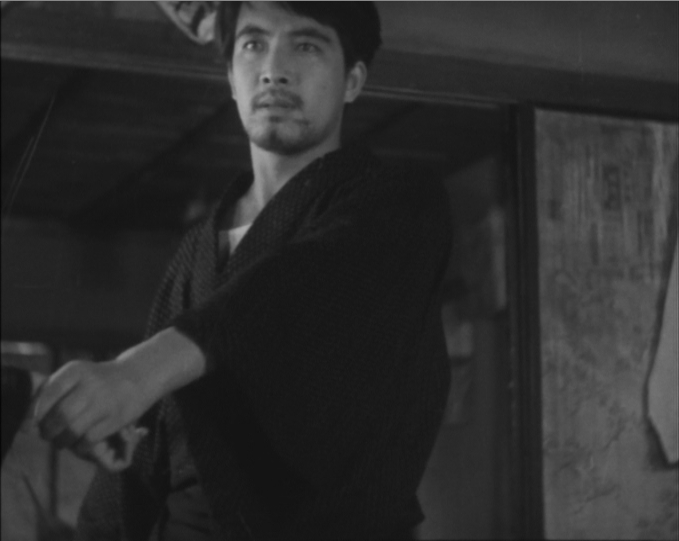
Ozu, Narrative Structure, Passing Fancy: Donald Richie claims that with each succeeding film Ozu would use a simpler story and Ozu uses the story as a mere background to explore the way his characters react to them. This becomes evident in Passing Fancy because it is simply a story about a single father and his relationship to his son and everything else that happens is simply in the film to explore this relationship. This becomes clear with the love triangle that is going on in the film. If this was a Hollywood film this would probably the whole basis of the film ending in some tragic consequence with the men killing each other or everything turning out fine for all three characters. Ozu uses this story element simply as a background to the father-son relationship. Not only does he not focus on the love triangle but around two-thirds into the film he disposes of it completely and it is almost like he starts over with a new story about a sickly son. This “second” story that Ozu introduces, even more so than the love triangle, really reiterates his focus on the relationship between the two. This loose narrative structure is another aspect of Ozu’s cinema that would be very hard to get away in a studio in Hollywood at the time where reliance on story was (and still is) enormously significant, it also recalls the type of rambling tales the naniwa-bushi performers, as shown at the beginning of the film, usually told.

Also, the famous match cut in the film:

establishing shot

Clearly breaking continuity, Ozu's frames both characters in the same exact spot and position:

shot

reaction shot